What is spunlace nonwoven fabric? The production equipment, process flow and quality control methods of spunlace nonwoven fabric.
Feb 11,2026
What is spunlace nonwoven fabric?
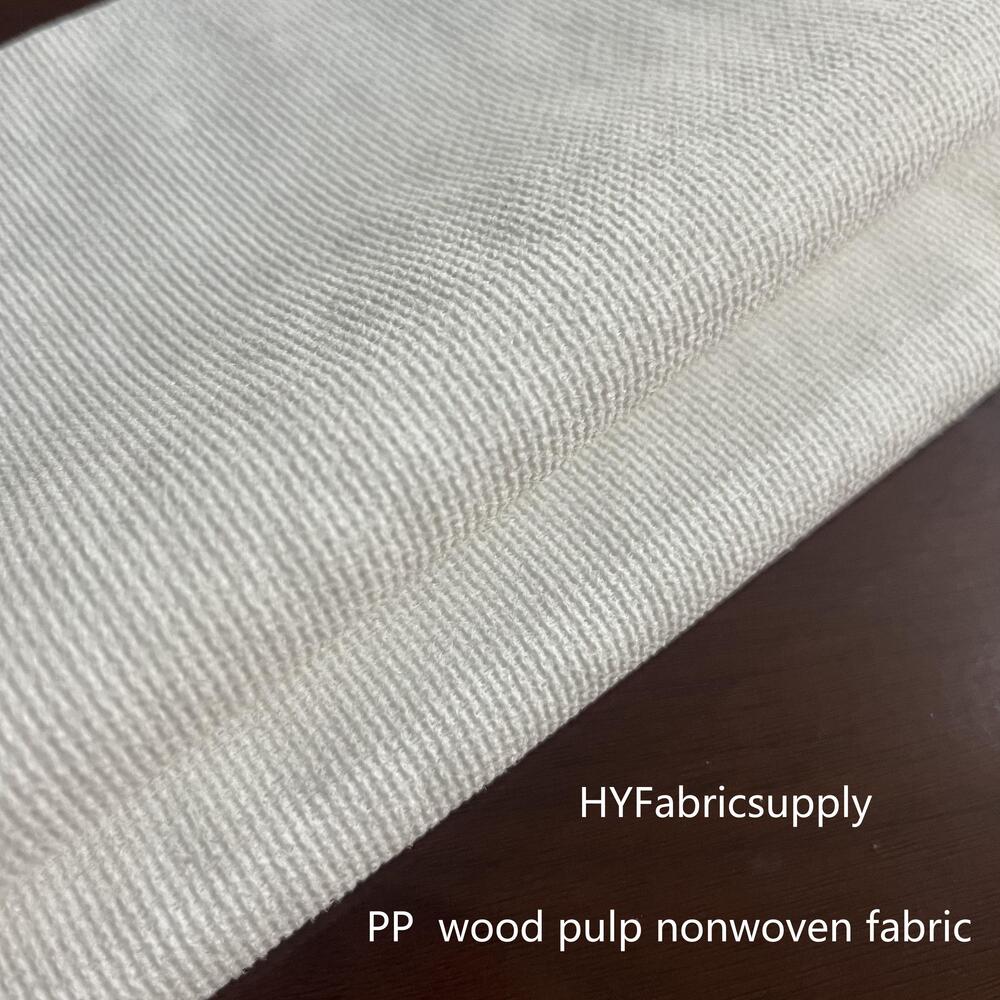
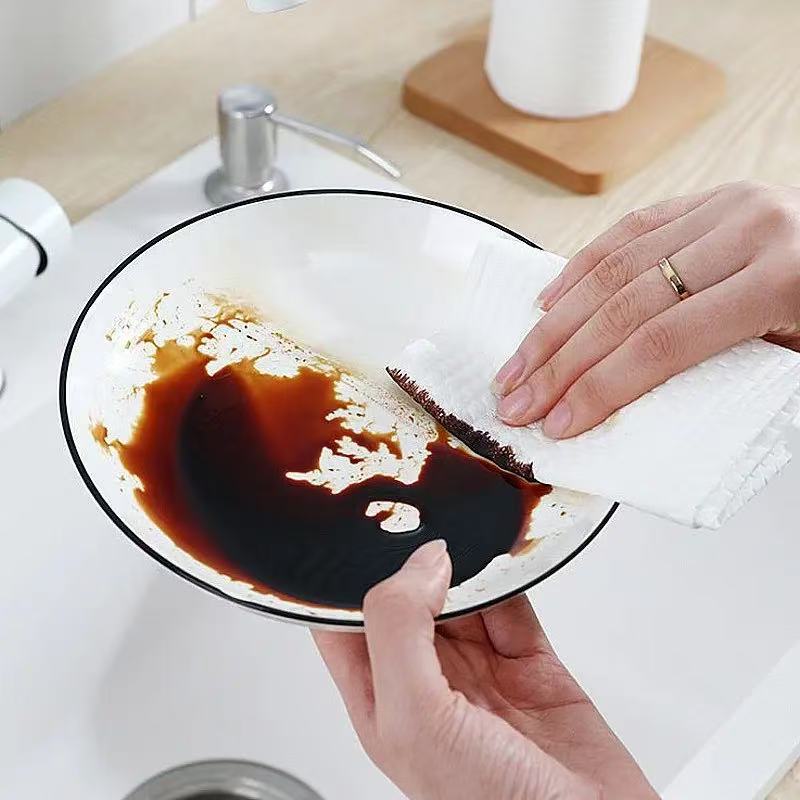
Spunlace fabric is an environmentally friendly and practical new material. Its core production principle is to entangle and reinforce the fiber raw materials through high-pressure fine water jets, thereby forming a non-woven fabric with certain strength and thickness. It does not require spinning, weaving, thermal bonding or chemical bonding, etc. This fabric has the characteristics of being environmentally friendly, safe, soft, highly absorbent and having good air permeability. It is widely used in home cleaning, medical and health care, industrial cleaning and manufacturing, and other fields.
Production equipment, processes and quality control methods of spunlace nonwoven fabric.
In both life and work, many friends have come across spunlace non-woven fabrics, such as various cleaning wipes, multi-functional kitchen cleaning cloths, makeup removal pads, and so on. However, most people probably don't know how spunlace non-woven fabrics are produced. Shandong Hengyao Non-Woven Fabric Co., Ltd. is a professional manufacturer and supplier of spunlace non-woven fabrics. The company has multiple production lines and product processing lines, and can provide corresponding customized production services according to different customer requirements. Now, let me introduce to you the production process, quality control methods, and factors affecting the price of spunlace non-woven fabrics of Shandong Hengyao Non-Woven Co., Ltd.
Step 1: Selection and Preparation of Ingredients
At present, the most commonly used raw materials for spunlace non-woven fabrics in the market are viscose fibers, polyester fibers, bamboo fibers and cotton fibers. Among them, viscose fibers and polyester fibers are the most commonly used due to their relatively lower prices. These two types of raw materials are always stocked in the warehouse in large quantities, so the minimum order quantity for spunlace non-woven fabrics is relatively low, usually 1 ton. However, bamboo fibers have a higher price and are used less frequently. Therefore, our warehouse does not have raw materials in stock. If we need to use this type of raw material, we need to plan and purchase it, so the production cycle will be relatively longer, and the minimum order quantity is usually 5 tons.
What are the differences between viscose fibers and polyester fibers?
Viscose fibers belong to man-made fibers (recycled cellulose fibers), while polyester fibers belong to synthetic fibers (polyester fibers). There are fundamental differences in raw materials, production processes, and core performance between the two.
Raw Materials and Classification
Viscose Fiber: It is made from natural cellulose (such as wood pulp, cotton pulp) through a chemical dissolution and regeneration process, and belongs to man-made fibers.
Polyester: It is made from petrochemical products (such as terephthalic acid, ethylene glycol) through a polymerization reaction, then spun into fibers, and belongs to synthetic fibers.
Core Performance Characteristics
Hygroscopicity and Comfort Level
Viscose Fiber: It has extremely strong hygroscopicity, with a specified moisture regain rate of about 13%, and is known as a "breathing fabric", providing good wearing comfort.
Polyester: It has poor hygroscopicity, with a specified moisture regain rate of only about 0.4%, poor breathability, and is prone to a feeling of heat when worn.
Strength and Durability
Viscose Fiber: Its dry strength is acceptable, but its wet strength significantly decreases, and its wear resistance is poor, and it is not resistant to washing.
Polyester: It has high strength, good wear resistance, similar wet and dry strength, and is durable and crease-resistant.
Appearance and Feel
Viscose Fiber: It has a soft and smooth feel, good luster, but poor elasticity, prone to wrinkling and has a large shrinkage rate.
Polyester: It is stiff, has good elasticity, good shape retention ("washable and wearable"), but the feel is relatively hard and lacks the soft texture of natural fibers.
Other Characteristics
Thermal Insulation: The thermal conductivity of polyester (about 7.3) is lower than that of viscose fibers (about 11.0), so polyester usually has better thermal insulation.
Dyeability: Viscose fibers have good dyeability; polyester is difficult to dye and usually requires high-temperature and high-pressure processes.
Environmental Friendliness: Viscose fibers can be biodegraded; polyester has mature recycling technology, but natural degradation is difficult.
Simple Identification Method
Combustion Method: Viscose fibers burn quickly, with a burning paper smell, and the ash is fine; polyester burns when melting into beads, emits black smoke, has a pungent smell, and leaves hard residues.
Wet Strength Test: After being wet, it is easily broken by the one with viscose fibers, while cotton or polyester is more resilient.
In summary, the hygroscopicity of viscose fibers is higher than that of polyester fibers. This indicator is also an important factor for water-activated nonwoven fabrics when used as cleaning products. The price of viscose fibers is higher than that of polyester fibers, so the proportion of viscose fibers added is the main factor affecting the price of water-activated nonwoven fabrics. The higher the proportion of viscose fibers added, the higher the price of water-activated nonwoven fabrics will be. This is also the reason why fabrics that look the same in appearance have different prices.
Step 2: Opening of a single type of fiber raw material
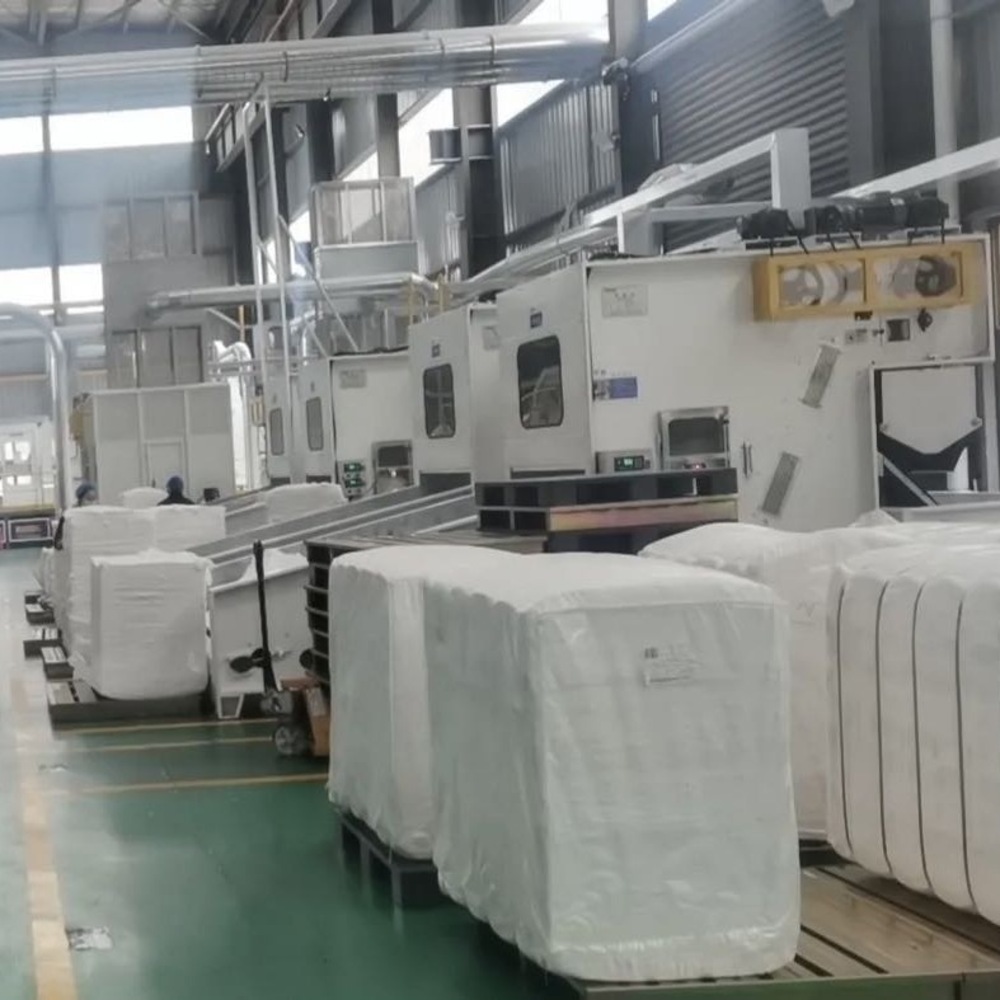
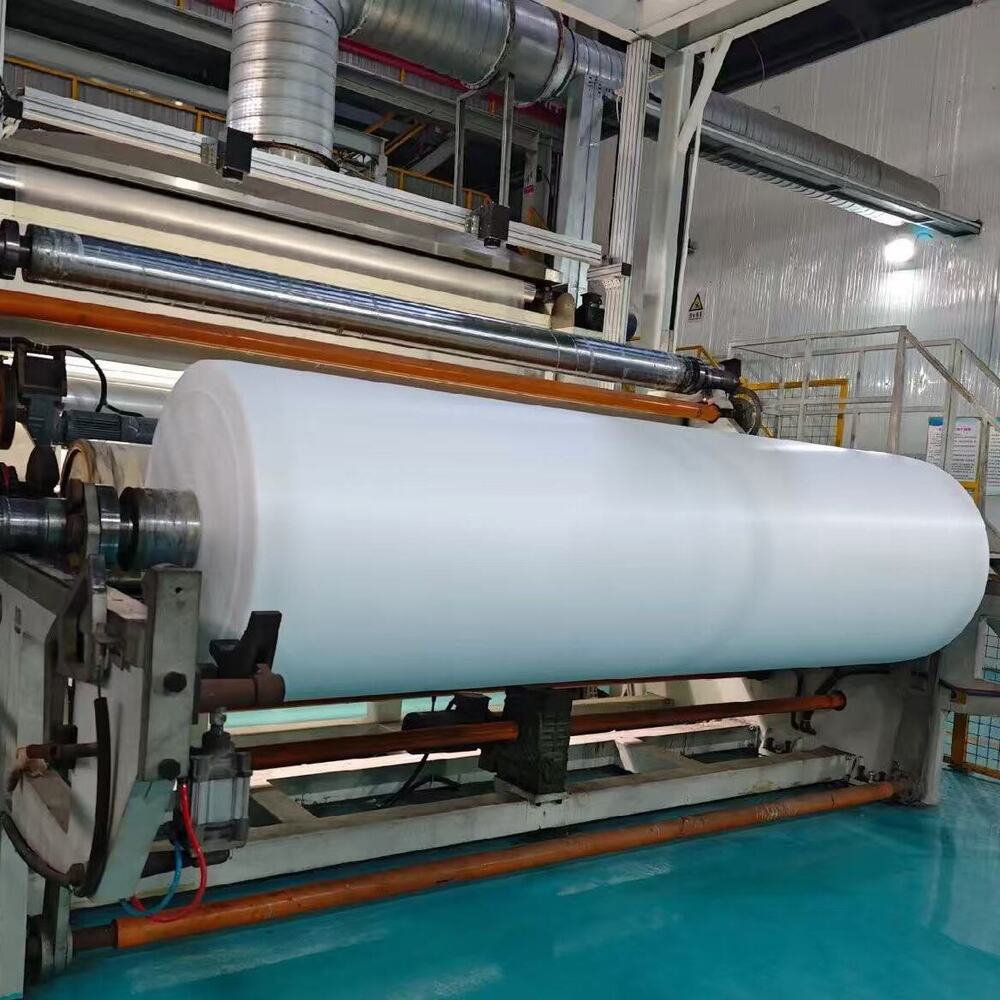
For the convenience of transportation, the fiber raw materials are compressed into fiber blocks during packaging. Before using them, we need to loosen the compact fiber blocks into fluffy fiber bundles or small fiber clusters. For this step, we will use a loosening machine.
Main components of the loosening machine: The main components of the loosening machine include the feeding conveyor belt, inclined nail curtains, beating wheels, and weighing hopper.
Working principle of the loosening machine: We place the fiber raw materials on the conveyor belt, and the conveyor belt transports the materials to come into contact with the inclined nail curtains. When the inclined nail curtains rotate, the large fiber clusters are torn into small pieces. If the small pieces of fibers can meet the usage requirements, they will be sent into the weighing hopper by the inclined nail curtains. If the fiber clusters are relatively large, the beating wheels will separate them from the inclined nail curtains and send them back. After repeated operations, the large fiber clusters will meet our usage requirements.
Different raw materials require separate loosening machines because after loosening, the materials need to be weighed through the hopper. The purpose of weighing is to control the addition ratio of the raw materials and stabilize the fiber ratio. We will complete the customer's requirements for the fiber ratio at this step.
Step 3: Fiber blending and loosening
After being proportionally weighed, the fibers will be sent together into the mixing and loosening section. In this step, the fibers will be preliminarily mixed, but the mixing is not uniform. At the same time, the small fiber clumps will be torn into smaller pieces. Then, they will be sent to the next step through the air conveying system.
Step 4: Fiber Mixing Box
After being carded, the fibers will be sent into the mixing box by the air conveying system. In the mixing box, the fibers are thoroughly mixed and homogenized under the action of wind and inclined wire curtains, meeting the usage requirements.
Step 5: Air Pressure Fiber Box
The uniformly mixed fibers are sent into the pneumatic fiber box by the air conveying system. The function of the pneumatic fiber box is to make the fibers form a uniform fiber layer under the action of wind force. The density of the fiber layer directly affects the weight of the spunlace non-woven fabric. The more uniform the fiber layer density is, the more uniform the weight of the spunlace non-woven fabric will be. At the same time, the weight of the spunlace non-woven fabric is also controlled and adjusted at this step.
Step 6: The machine combs the fibers
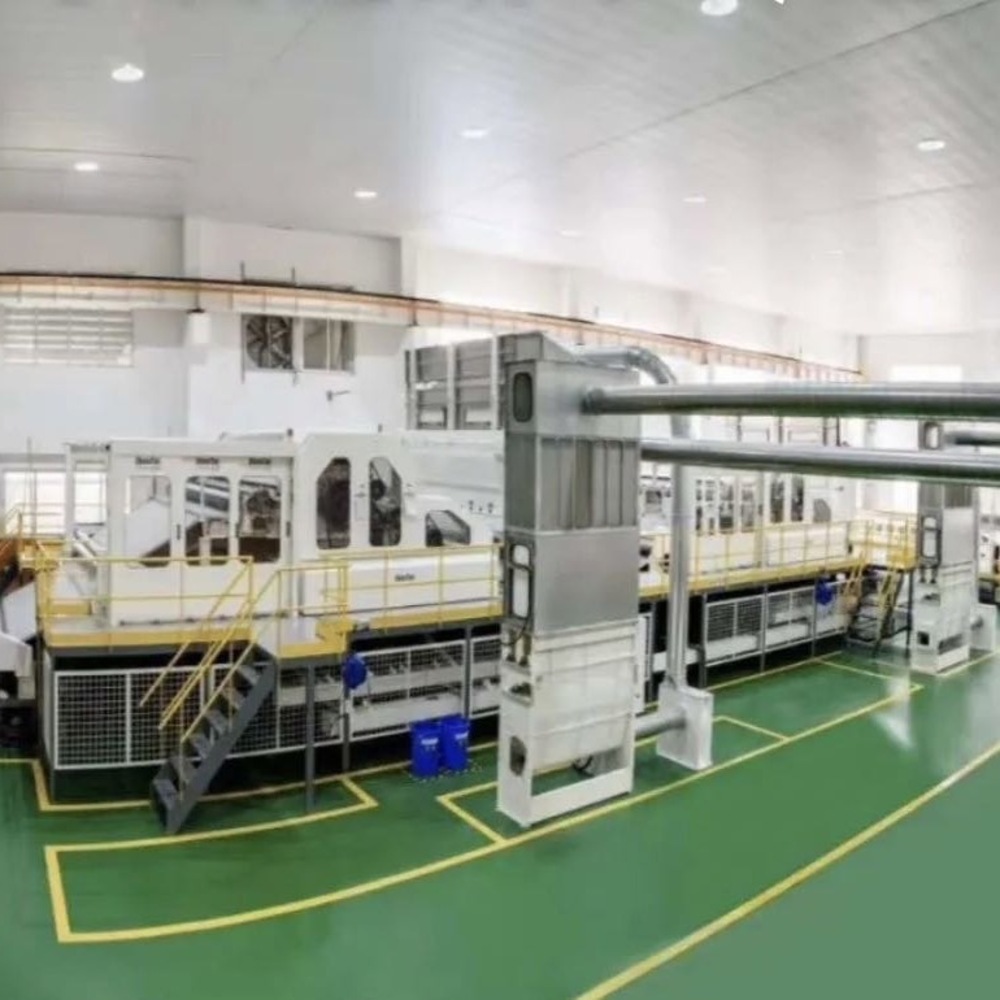
The main components of the combing machine: feeding needle roller, large sliver cylinder, fiber separation roller, wind-blocking roller, etc. The surfaces of these rollers are all covered with different types of needle cloth. The selection of needle cloth type depends on the material and length of the fibers.
The working principle of the combing machine: Through the rotational speed differences of these rollers with needle cloth, the fibers are continuously combed into a fiber web arranged in the same direction.
The control of the parameters of the combing machine directly affects the uniformity of the web formation of the spunbond non-woven fabric. The more uniform the fiber web after combing, the better the quality of the spunbond non-woven fabric.
Step 7: Cross-laying Machine (This step is not required for laying water-sprayed non-woven fabric in a straight manner)
After being processed by the combing machine, the fibers are arranged in the same direction. If we do not use the laying machine and directly proceed to the next production stage, we call this a straight-laying production line. The transverse tensile force of the spunlace non-woven fabric produced by this process is much lower than the longitudinal tensile force. The price of the spunlace non-woven fabric is also slightly lower.
If we use the laying machine to lay the fabric, we call this an interlaid production line. The spunlace non-woven fabric produced by this process has a relatively small difference in tensile force in both the transverse and longitudinal directions. Depending on different usage requirements, we can choose half-interlacing or full-interlacing.
Step 8: High-pressure water injection
The working principle of high-pressure water jet is that the force generated by the flow of high-pressure fine water columns drives the interweaving of the upper and lower fibers. After the fibers are interwoven, the tensile strength of the water-jet non-woven fabric will be enhanced. At this step, different patterns such as plain weave, pearl weave, EF weave, etc. can also be formed on the water-jet non-woven fabric. The mesh size of the water-jet fabric can also be controlled. The most common ones include 10 mesh non-woven fabric and 22 mesh non-woven fabric. All of these can be customized according to customer requirements.
Step 9: Drying
After passing through the water injection section, the fibers contain a large amount of moisture. Therefore, we need to use a steam-heated dryer to dry the moisture from the water-stitched non-woven fabric. If it is for producing white base fabric, after drying the moisture, we can directly roll it up. However, if it is for online printing, we need to control the moisture content of the water-stitched non-woven fabric to be between 30% and 40%.
Step 10 Embroidery
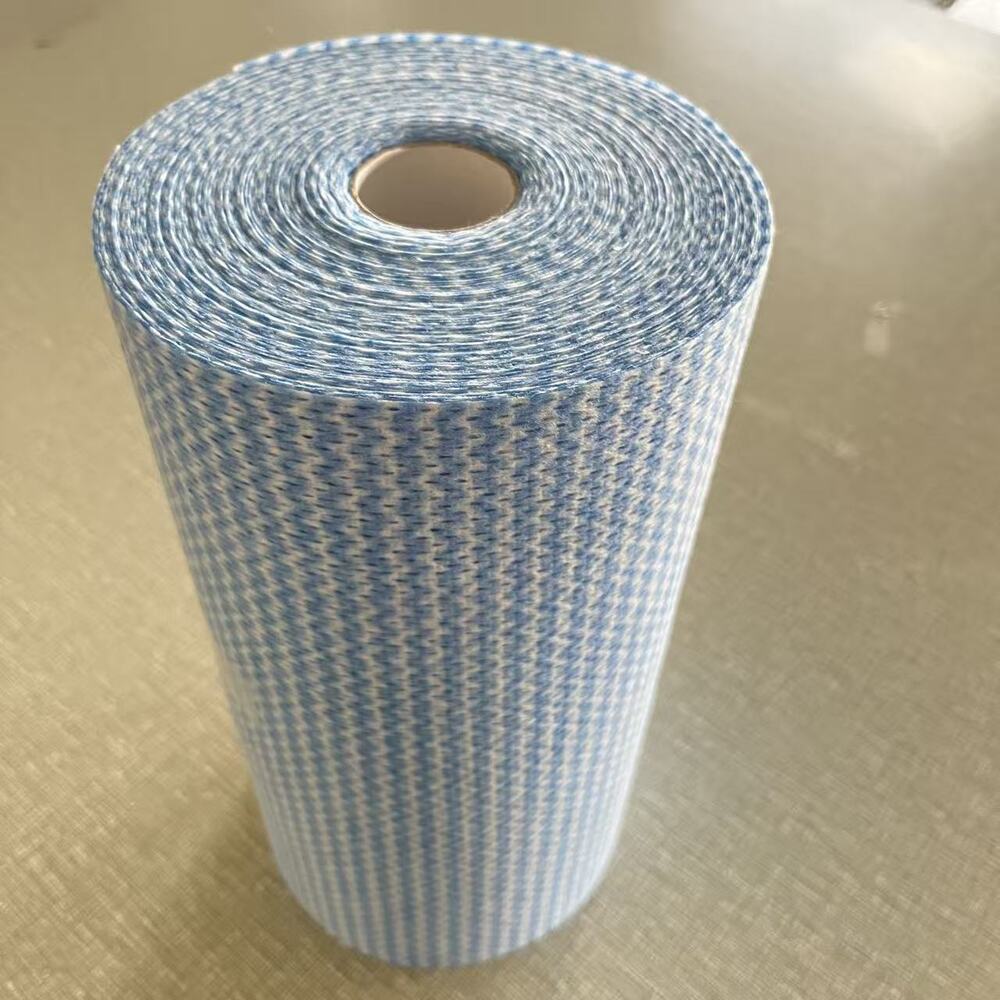
The common lazy mops, multi-functional cleaning cloths and kitchen cleaning cloths we encounter in our daily life all feature patterns such as waves and diamonds. These patterns are applied in the printing area. We can control the patterns, colors, styles, brand logos, etc. of the printing.
Step 11: Drying
After the water-spraying non-woven fabric undergoes printing, it continues to pass through the drying section for drying, which removes the remaining moisture from the fabric and reinforces the color of the printing to prevent color fading.
Step 12: Rolling and Coiling
The water-sprayed fabric after drying can be directly rolled into large rolls and undergo quality inspection at the same time.
Step 13: Cutting into Pieces
Cut the large rolls into different widths and lengths as per the customer's requirements.
Step 14: Folding Processing
According to the customer's specified size and folding method, use professional folding equipment to fold it, or make it into a tearable rolled water-activated non-woven fabric cleaning cloth.
Step 15 Packaging
Purchase the corresponding packaging materials according to the customer's requirements and carry out the packaging as per the specifications.
At this point, the entire production process of the product has been completed. This is our production process for water-jet non-woven fabric towels or multi-functional cleaning cloths. Every step in the production is very important, and the control of each step's process parameters will directly affect the quality of the product. Of course, the production processes of water-jet non-woven fabrics for different purposes will be different. Shandong Hengyao Non-Woven Fabric Co., Ltd. has many years of experience in water-jet fabric production. We welcome everyone to communicate and learn from us. Also, customers who need water-jet non-woven fabrics are welcome to consult us about prices.
Contact number: +8615908001621
WhatsApp: +8615908001621
Email: sales@hyfabricsupply.com
 WhatsApp
 Email
Email
 15908001621